





Long before modern highways, cargo ships, and airplanes connected the world, ancient trade routes allowed people, goods, technologies, and ideas to travel across vast distances. These routes were much more than paths for exchanging products. They helped civilizations interact with one another and contributed to the development of languages, cultures, religions, technologies, and cities. The […]
Long before modern highways, cargo ships, and airplanes connected the world, ancient trade routes allowed people, goods, technologies, and ideas to travel across vast distances. These routes were much more than paths for exchanging products. They helped civilizations interact with one another and contributed to the development of languages, cultures, religions, technologies, and cities.
The Importance of Trade in the Ancient World
Ancient communities did not have access to all the natural resources they needed. One region might have fertile farmland, while another had valuable metals, timber, gemstones, spices, or textiles.
Trade allowed communities to exchange resources that were unavailable locally. Merchants transported goods between towns, kingdoms, ports, and distant civilizations. As trade expanded, commercial networks became increasingly complex.
These connections also encouraged the growth of marketplaces and settlements along important routes.
The Silk Roads
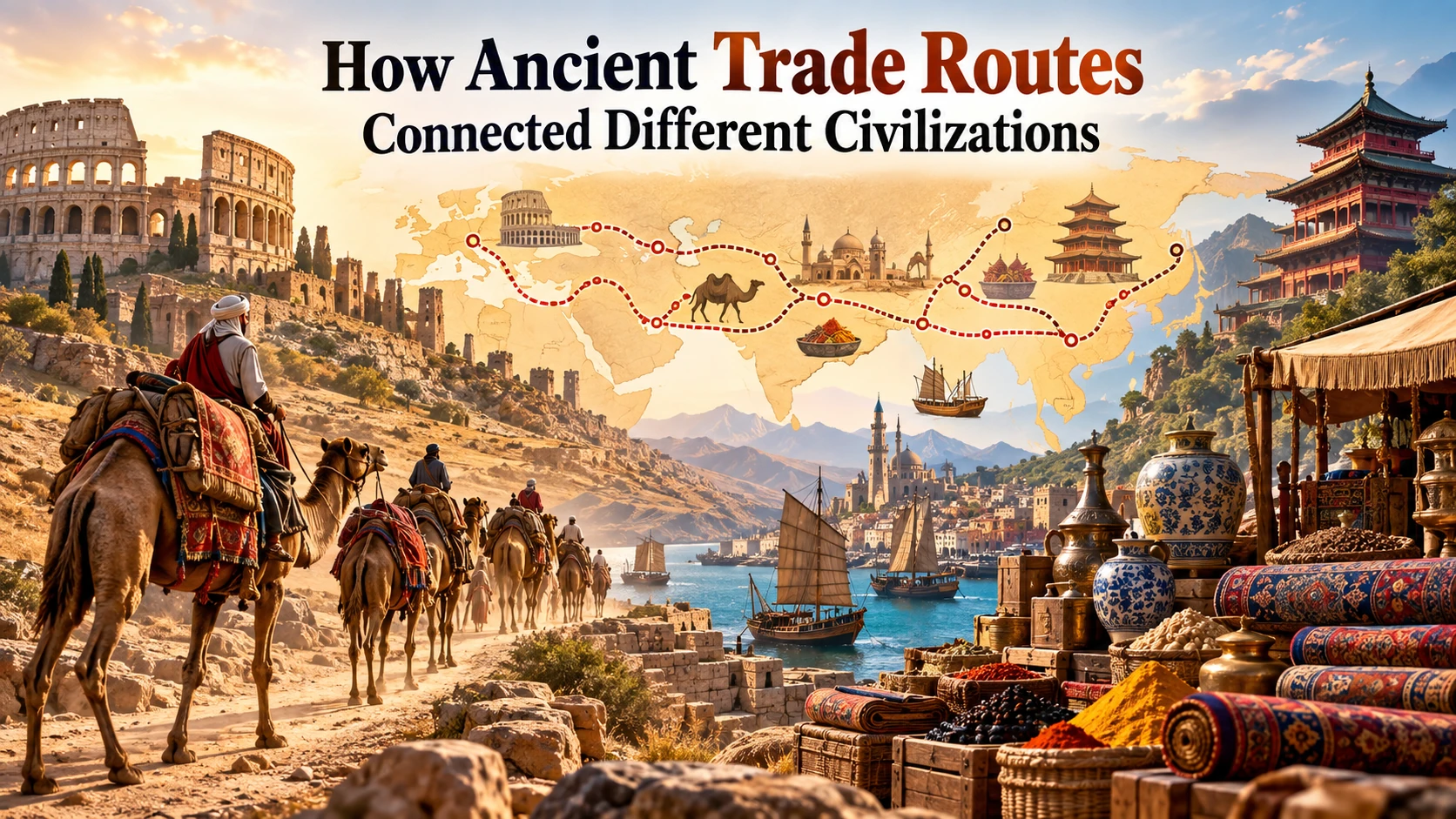
The Silk Roads are among the best-known examples of ancient and medieval trade networks. Rather than being one single road, they consisted of interconnected land and maritime routes linking parts of East Asia, Central Asia, the Middle East, and Europe.
Silk was one of the famous products transported along these networks, but merchants also traded spices, precious metals, textiles, ceramics, glassware, and other goods.
Cities located along these routes could become important centers of commerce because travelers needed places to rest, trade, store goods, and obtain supplies.
Maritime Trade Across the Indian Ocean
Sea-based trade was equally important. The Indian Ocean connected East Africa, the Arabian Peninsula, South Asia, Southeast Asia, and other regions.
Merchants used knowledge of seasonal winds to plan maritime journeys. Ships carried goods such as spices, textiles, precious stones, ceramics, metals, and agricultural products.
Ports became meeting places where merchants from different cultural backgrounds interacted. These exchanges contributed to cultural diversity in many coastal communities.
Trade Spread Ideas and Knowledge
Trade routes did not carry products alone. Travelers also carried knowledge.
Farmers, craftsmen, sailors, scholars, and merchants encountered techniques and ideas developed in other regions. Agricultural practices, mathematical knowledge, navigation methods, artistic styles, and manufacturing techniques could spread through these interactions.
This process was not always immediate. Ideas could move gradually from one community to another as travelers and local populations exchanged knowledge.
Religion and Cultural Exchange
Trade networks also contributed to the movement of religious and cultural traditions. Merchants and travelers carried beliefs, stories, customs, languages, and artistic traditions to new places.
Religious communities sometimes developed along major commercial routes because travelers and merchants established settlements or interacted with local populations.
This helped create multicultural communities where different traditions could coexist and influence one another.
The Growth of Cities
Trade routes played an important role in the development of many ancient cities. Locations near rivers, mountain passes, ports, and crossroads often offered advantages to merchants.
As commercial activity increased, settlements could develop markets, warehouses, workshops, inns, religious buildings, and administrative centers.
The economic importance of these cities could attract people from distant regions, making them centers of cultural exchange as well as commerce.
Challenges Faced by Ancient Traders
Ancient trade was not easy. Merchants faced deserts, mountains, storms, difficult terrain, disease, theft, political conflicts, and long travel times.
They often traveled in groups or relied on established networks for protection and supplies. Caravanserais and other stopping points provided places for travelers and animals to rest along some major routes.
These challenges made reliable trade networks particularly valuable.
Trade Routes and Cultural Diversity
When people from different civilizations interacted regularly, cultural exchange became more likely. Food traditions, clothing styles, artistic techniques, architectural ideas, and languages could influence one another.
Some cultural similarities found across distant regions can therefore be understood partly through centuries of contact and exchange.
However, cultural exchange did not mean that civilizations simply adopted everything they encountered. Communities often adapted foreign ideas to their own traditions and circumstances.
The Long-Term Impact
Ancient trade networks helped create connections that extended far beyond individual commercial transactions. They encouraged economic development, supported cities, facilitated cultural exchange, and contributed to the movement of knowledge across regions.
Their influence can still be seen in historical cities, archaeological discoveries, languages, artistic traditions, and cultural practices.
Final Thoughts
Ancient trade routes were some of humanity’s earliest large-scale networks. They connected communities separated by enormous distances and allowed more than goods to travel.
Merchants carried products, but travelers also exchanged knowledge, beliefs, technologies, stories, and cultural practices. These interactions helped shape societies and created connections between civilizations that influenced world history for centuries.